What It’s Like to Ride a Motorcycle Through the Himalayas
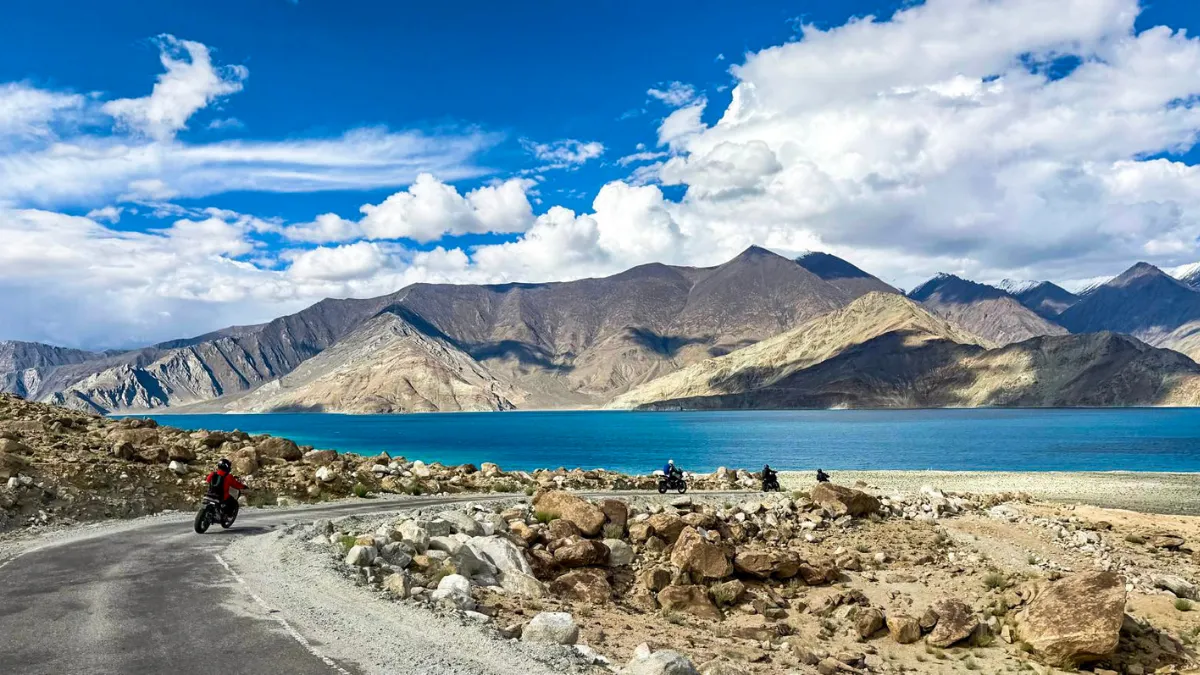
Of all the tours Ride Expeditions run, the Himalayan ones come back again and again as the rides our leaders most look forward to. From the moment you land in Delhi you can feel it, and once you are out in those enormous landscapes you understand why. From the towering peaks beyond Leh to the wide glacial valleys at Nubra, the rush of the Indus, the narrow roads chiselled straight into the rock and the cold blue of Pangong Lake, India piles it on, one staggering view after another.
So, to help you work out which tour suits you – or just which one to ride first – here is what to expect on a Himalayan trip, and most of what you need to know to stop dreaming and start booking. There is a whole world of roads out there. Let us ride them.
Four tours, one massive landscape
There is so much country here you could spend months exploring it, so to make things simpler, we have built four Himalayan motorcycle tours to choose from. If you are up for the big one, Himalayan Legends is it – twenty days and just over 2,500 kilometres, starting at Kufri just outside the old colonial capital of Shimla, then on through some extraordinary places: the ancient town of Nako, the splendour of Pangong, the soaring peaks themselves. Around fifteen hundred miles of jaw-dropping scenery.
If that is a touch much, our favourite is the Himalayan Heights, which has been running for over ten years. At around 1,700 kilometres over thirteen days it is still a big trip, taking in massive valleys, crashing streams and the remarkable Umling La, one of the highest motorable roads in the world at 5,798 metres above sea level. Reaching the pass is the goal, though never a given – it sits in a tightly controlled border region and can close at short notice, so we always have an alternative route ready (more on that in the FAQs). It is also the tour Top Gear’s Richard Hammond brought his mates on.
Third on the list is Valley of the Gods, and when you ride it you will see how it got the name. It is 1,160 kilometres of pure motorcycling pleasure, from Delhi, up through the remote Spiti Valley, to pulling off your helmet in the bustling city of Leh, in the astonishing Ladakh region. Big skies, big scenery and big smiles for eleven days.
Last, but no less of a ride, is the Himalayan Escape, which packs the high country into just over a week. At 1,185 kilometres over eight days it is a Leh-based loop, running out over Khardung La to the Nubra Valley and on to the deep blue of Pangong Lake, with Umling La in reach too. If eight days is all you can spare, it is a fine taste of the Himalayas – and one of this year’s riders wrote the whole thing up in a first-hand account of the Himalayan Escape that is well worth a read.
Whichever you choose, riding here is never dull. It is physical, it is demanding and it is beautiful, in equal measure. With somewhere between 200 and 300 kilometres to cover most days, you need to be comfortable with long hours in the saddle, confident on variable roads, happy riding in a group, and, above all, up for a good time. Sound like you?
The best roads, and the worst roads
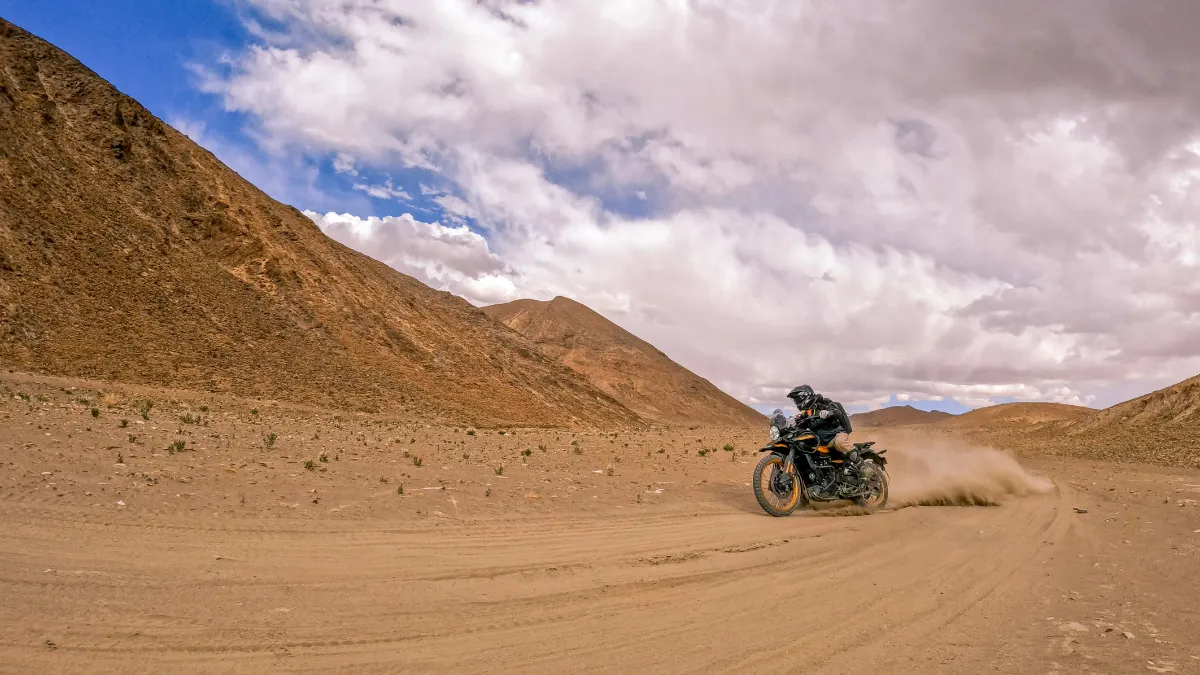
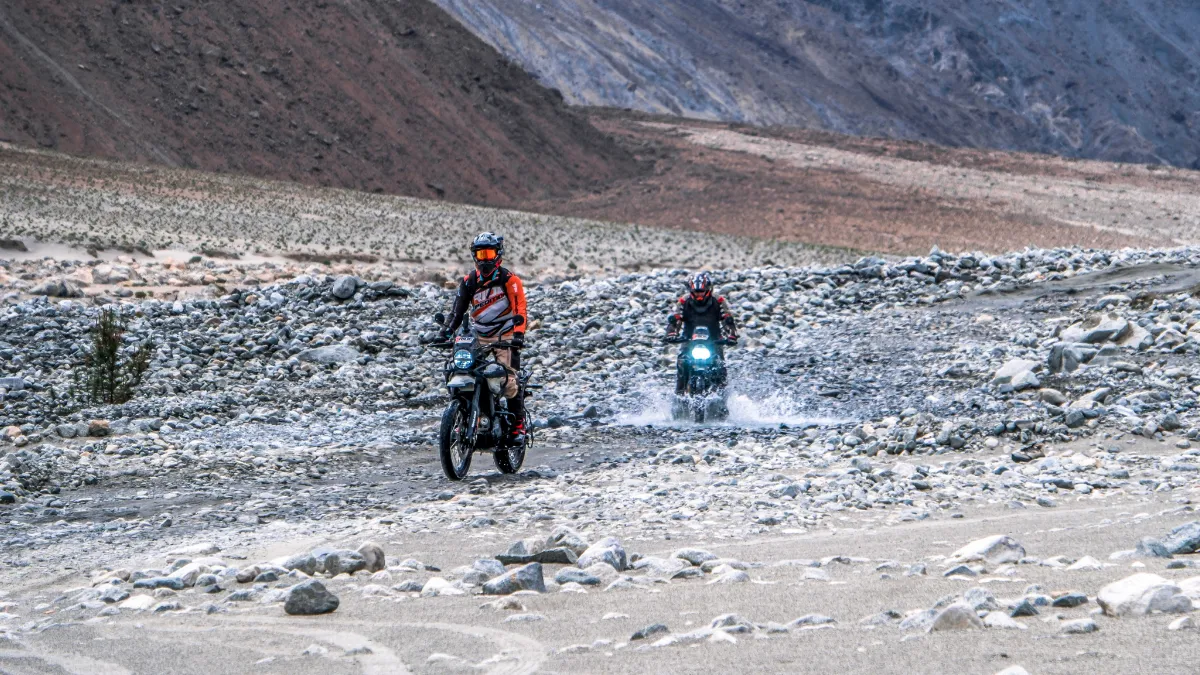
If you have never ridden in India, you may not be ready for just how variable the roads can be. One minute you are on a ribbon of grey silk laid across an epic landscape, the next you are on a rock-strewn track with water running across it, and in between there is everything from hard-packed mud to wide gravel for mile after mile. To ride the Himalayas you take both as part of the deal, so if you are after perfect tarmac and fast riding, India cannot offer that. What it can offer is the pure pleasure of being on a motorcycle, riding with old friends and new, simply enjoying the road, with a support vehicle, a spare rider and a doctor on call so you are never out here on your own. We do set a pace to reach each night’s stop in time, so it is not quite a Sunday potter, but to ride here with the throttle pinned misses the point. This place is special. Enjoy it.
Water babies
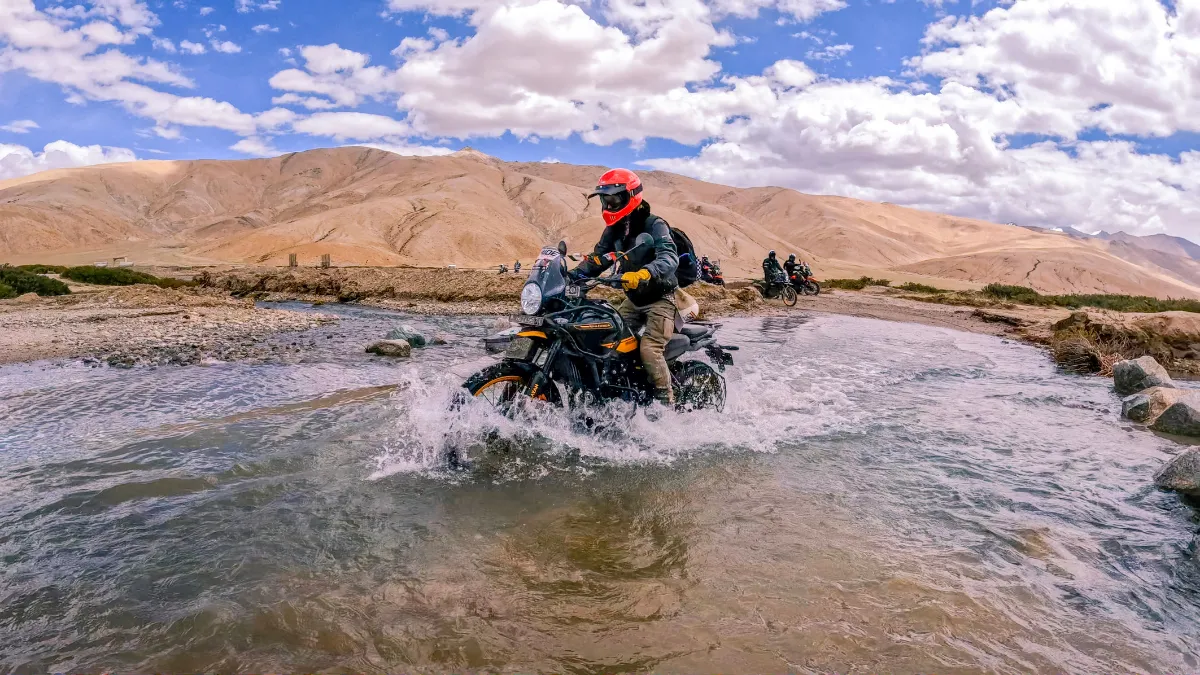
If there is one thing the Himalayas have in abundance, apart from mountains, it is water. From the big rivers we follow to the torrents crashing off the cliffs and across the road, water crossings are very much part of the deal up here. Whether it is easing over a narrow mountain bridge or standing on the pegs through hub-deep water in a glacial valley, it is all in a day’s riding. A good pair of waterproof boots, and maybe waterproof socks, is a sound investment – nobody likes wet feet. And if you have never stood on the pegs to cross a river before, by the end of these you will be an old hand
Sunshine and showers
We run the India tours in summer for the best of the weather, but temperatures still swing a lot as you travel from the hot, humid streets of Delhi up to the snow on the high peaks. In between you get bright sun, chilly mornings and, now and then, rain. So while riding in a jacket and jeans like Steve McQueen might feel perfect, we would suggest a little more flexibility in the wardrobe. You do not necessarily need a full adventure suit or enduro kit, but something along those lines, with layers, makes real sense. And, to be clear, full race leathers would be overkill here – save them for the track.
Heads and tails
So what about helmets, gloves and boots? The riding is predominantly road, even if the definition of road is flexible, so a road helmet is fine – though an adventure helmet gives you a bit more air in the rough stuff, and you will not be troubled by the peak catching at high speed. Given how much gravel and broken surface there is, we would steer you away from open-face helmets – there is a lot of loose stuff flying around out here, and a full face keeps your teeth where they belong. For footwear, go chunky: something that lets you stand on the pegs and protects your ankles and shins. Adventure boots beat thin-soled road boots, and waterproof ones will earn their keep at the crossings. Bring two pairs of gloves for the changing weather – one warm and waterproof, one lighter for the warm days.
Built like a gun
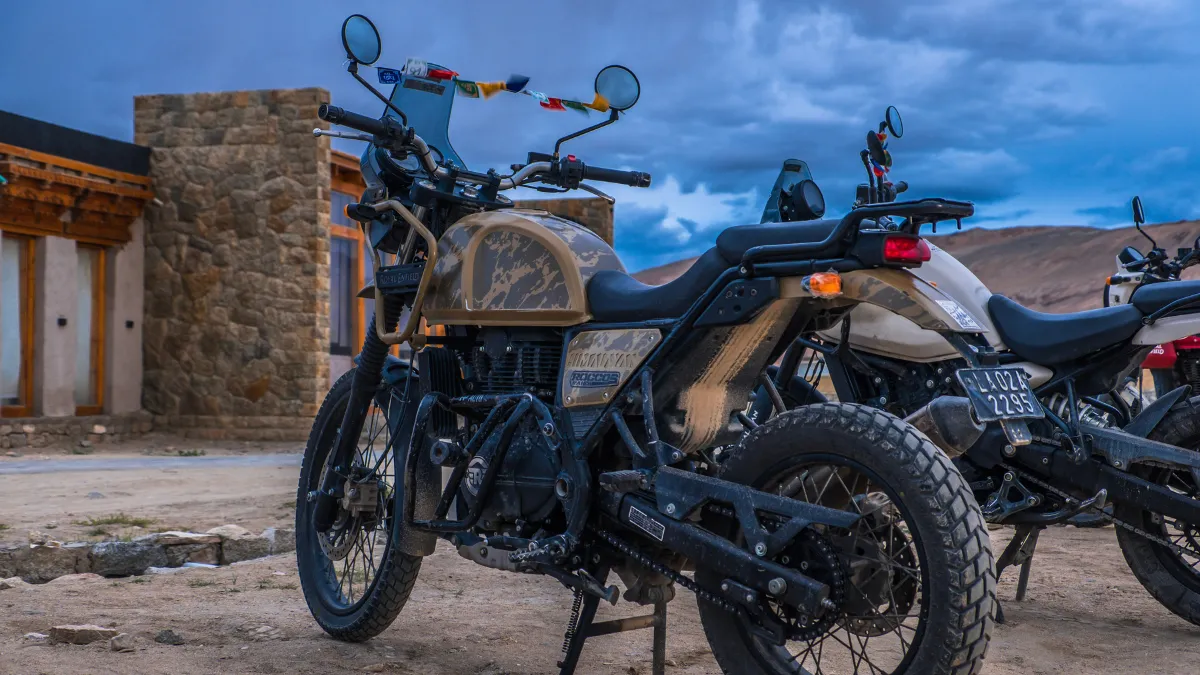
What will you be riding? For India there is really only one answer: the bikes that have been built in Chennai, formerly Madras, since the 1950s. To ride anything but a Royal Enfield through this country would feel wrong. We used the trusty 500 cc Bullets on our early Himalayan trips, but the arrival of a whole range of lighter, more capable Enfields has been a bonus for us and our riders, even if the Bullets did make you look cool. The Himalayan 450 is the perfect tool for the job and handles the variety as if it was designed for it, which it more or less was. From stony river crossings to sweeping highway, from endless switchbacks to gravel straights, the plucky Himalayan takes the lot in its stride. And for anyone used to bigger, more powerful bikes back home: leave them there. The soft, precise Enfield is exactly right for getting the very best out of the roads of northern India. On roads where the mountain rises on one side and falls away on the other, you want a bike that is precise and predictable, not one that wheelies in the first four gears.
Mountain tops to colourful shops
From the chaos of Delhi’s markets to the exquisite silks in the sari-shop windows, from the street-food smells of Leh to the incense outside the ornate temples and roadside stupas, and the constant barking of the street dogs, India is a glorious assault on the senses from start to finish. But as much character as the towns and villages have, it is the landscapes that really land. Until you have seen the high peaks ahead of you, the scale is hard to convey – it is simply vast. And that is before the wide glacial valleys and their meandering rivers, the tight mountain switchbacks, the monasteries perched on impossible cliffs, the other-worldly Spiti Valley and the tiny village of Nako with its winding lanes and ancient houses. India is an enchanting place to ride. You will love it.
So what is stopping you?
Hopefully that gives you a feel for the place and why the Himalayas are worth moving from someday to your calendar. Head to the Ride Expeditions site, open the Asia tab and go to the India section, where each tour is laid out in full: the day-by-day itinerary, the daily mileage, what the price includes and the dates available. You will also find the answers to the usual questions – what insurance you need, whether the food will be too spicy, what to pack, whether you need an international driving permit – and for anything to do with insurance or licences, check the detail with your own provider. If you would rather talk to a person than read, there is a live chat through to one of the team. there is a live chat, and you can ask to be put through to one of the team – people who have actually ridden the route. And do not worry if you are not coming with a group of mates – plenty of our riders sign up solo and finish the trip as part of a proper gang. Come and join us in the Himalayas. You will not look at a map of India the same way again.
Frequently Asked Questions
When is the best time to ride in the Himalayas?
We run the India tours through the summer, roughly late June to mid-September, when the high passes are open and the weather is at its best. Outside that window many of the passes are closed by snow, so the season is short and the good dates book up early.
How experienced do I need to be?
The riding is mostly road, but Indian roads are nothing like home: expect rough surfaces, gravel, the odd water crossing and long days of 200 to 300 kilometres. You need to be comfortable on variable surfaces and happy riding in a group, but you do not need hard off-road skills. The trips sit around five or six out of ten for difficulty, and there is a support vehicle and a spare rider with the group throughout.
What about the altitude?
It is real, and it affects everyone differently. The high passes are serious – Umling La tops out at 5,798 metres, one of the highest motorable roads in the world, and several others sit above 5,000 – so our routes build height gradually to give your body time to adjust, and we carry medical support with a doctor on call. If you have any medical concerns about riding at altitude, have a chat with your own doctor before you book.
Will we make it to Umling La?
Reaching Umling La – at 5,798 metres, one of the highest motorable roads in the world – is our objective for the day, but it is never a guarantee, and we would rather be straight with you about that. It sits in a sensitive border region, so access is controlled by the Indian Border Roads Organisation and the Indian Army, and the route can close at short notice for military, security or weather reasons, sometimes on the day itself with no warning. If it is closed when we arrive, there is a plan: we run a pre-agreed alternative route and your tour manager briefs you on the change as soon as the call is made. Either way, it is a big day in extraordinary country.
Which of the four tours should I choose?
Himalayan Legends is the full expedition – twenty days, Shimla up to Ladakh. Himalayan Heights is the thirteen-day classic, Delhi to Leh, taking in Umling La. Valley of the Gods is eleven days from Delhi to Leh through Spiti. And Himalayan Escape is the short option, an eight-day Leh-based loop for when time is tight. Tell us how long you have and how you like to ride, and we will point you at the right one.
What bike will I be on?
The Royal Enfield Himalayan 450 on all four tours. It is light, friendly and built for exactly this kind of riding – far better suited to the mountains than the big, powerful machines you might ride at home.
Do I need a special licence or permit?
You will need a full motorcycle licence and, for India, an International Driving Permit. The inner-line permits for the restricted border areas are arranged as part of the tour. Licence and permit rules vary by country, so confirm what you personally need with your own licensing authority before you travel.